Blog 13: VOICES Spring Interns
By Darcy Rougeaux and Amelia Seepersaud
This Spring VOICES took on two interns, masters students Darcy Rougeaux and Amelia Seepersaud. Darcy, Social Media Intern, spearheaded the presence of VOICES on social media platforms like Instagram, BlueSky, and LinkedIn. Amelia, Digital Humanities Intern, applied her knowledge of the Digital Humanities to verify accuracy of VOICES data and to develop Controlled Vocabulary terms.
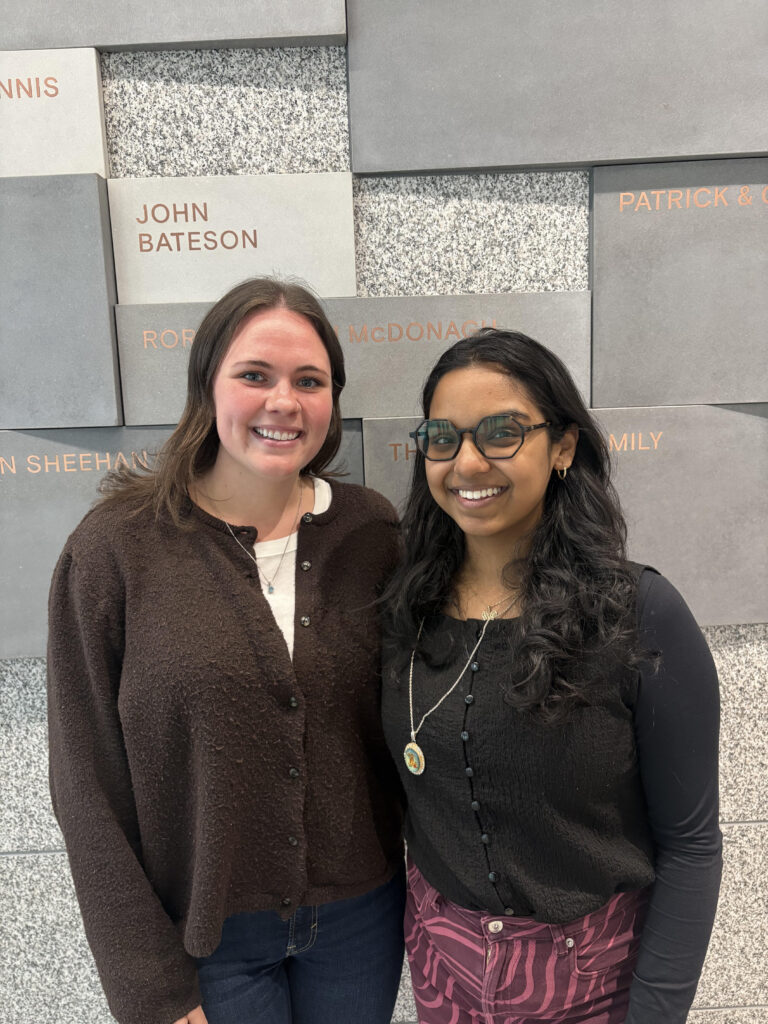
Darcy Rougeaux and Amelia Seepersaud
Amelia’s Spring with VOICES
When I first learned of the VOICES Project I was immediately intrigued by its premise as a project dedicated to highlighting the women of Early Modern Ireland. My interests often lie in projects that endeavor to tell stories from the perspective of groups and communities that are overlooked and underrepresented in historical and cultural narratives. So you can see how the VOICES project drew my interest. VOICES aims to reanimate the lives and stories of the Women of the Early Modern Era because in the telling of history, these are the perspectives that rarely make it into the pages of history books. I was fascinated by the focus on reframing the narrative of Early Modern Irish Women not simply existing within history, but playing active roles in the shaping of it. I was further intrigued by the project’s emphasis on using digital tools to innovate the ways in which historical data could be understood and represented. In joining the team as a Digital Humanities intern this semester, I was able to gain first-hand experience on how digital tools can be used to transform historical data into rich cultural and historical narratives.
During my time with VOICES, I engaged with two aspects of the project:
- Developing Controlled Vocabulary terms pertaining to religion, national identity, rank, and honourifics
- The National Library of Ireland (NLI) Funeral Entry manuscripts
My work on the controlled vocabularies was primarily research-oriented. Examples of a controlled vocabulary would be Library of Congress Subject Headings (LCSH) or Getty Thesauri, which offers standardised, consistent terms to classify subjects. Developing a good controlled vocabulary is essential for any historical data project that is intended to be easily searchable by users. I drew on information available in academic literature, in the MACMORRIS Project (another digital history project focused on Early Modern Ireland), and on primary sources used by VOICES (i.e., National Library of Ireland (NLI) Funeral Entries and 1641 Depositions). Using these sources, I was able to consolidate hierarchical lists pertaining to the four relevant categories, which will ideally give the VOICES team a foundation as they continue to develop and build controlled vocabularies for these categories.
My work with the Funeral Entries arose out of a need for data verification. When VOICES received the 16 funeral entry manuscripts, they were accompanied by an Index compiled in 1994. Upon receipt, the team used Optical Character Recognition (OCR) technology to convert the index to a machine-readable format, and it is this data that the project relies on. However, the accuracy of the Index was still a bit uncertain. So, I was given the honor of kickstarting the process of verifying its accuracy. I worked with four of the sixteen manuscripts, GO MS 69 – 72. I went through the digitised copies of each of these manuscripts and recorded the names and volume references of women who had funeral entries dedicated to them within its pages. Once I had completed the compilation of this dataset, I used Python to cross-reference it with the Index. Through this process, we identified matches between the two datasets and also gaps in the Index, as well as, in?? my own compilation of the dataset. This cross-referencing process enabled the identification of human and machine error which can then be corrected to improve the accuracy of the data that VOICES is drawing from.
While not the focus of my internship with VOICES, one aspect of the work I did that particularly impacted me was the process of manually going through the funeral entry manuscripts. As I parsed through the manuscripts, page-by-page, searching for women within them, I became aware not of the presence of men but the absence of women. Within the 1,658 pages of the four manuscripts I worked on, less than 200 of them contained women. Surely there were just as many women as there were men during the Early Modern Era, and yet, their deaths (and by association the lives they led) are seldom recorded within these manuscripts.
It was also interesting to note how people were memorialised and how the funeral entries tell a story of the status certain individuals may have possessed. Most of the funeral entries, for both men and women, were primarily focused on familial bonds (i.e., spouses, parents, children). It was also quite common to note that most of the women identified within the pages of these manuscripts were firstly identified in relation to their closest male relative (father or spouse). For example, in GO MS 69 page 11r, Lettice Parsons is immediately identified as “wife to Richard Parsons.”
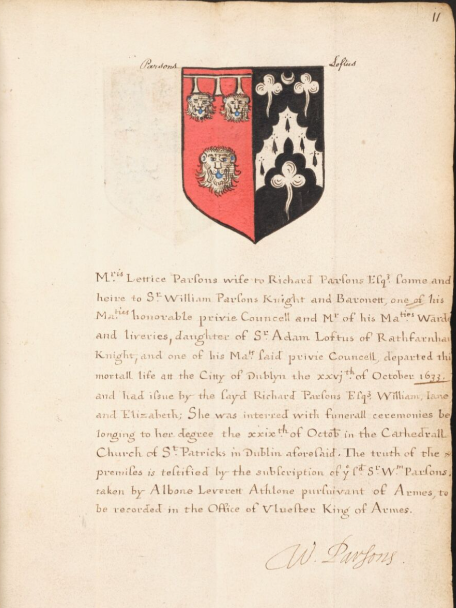
NLI GO MS 69 Page 11r
While for men (though some of them were identified in relation to their fathers first), many of them were identified in relation to geography before being identified in relation to their families. For example, in GO MS 71 page 15r, Nicholas Strong is identified as being “of Ballycowlan” before anything else.
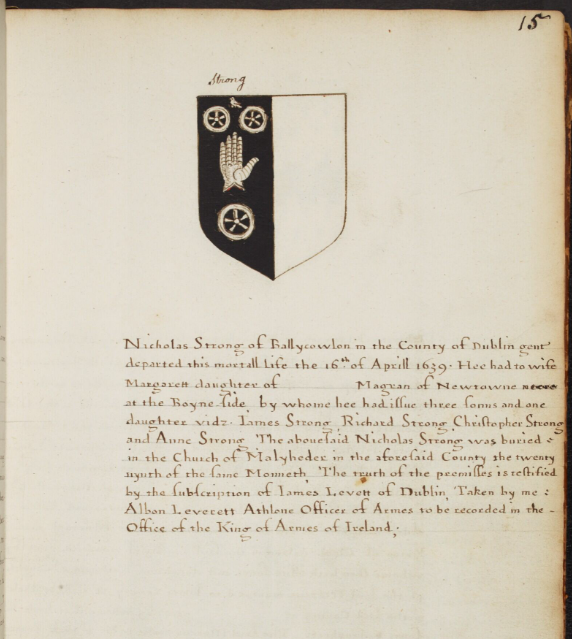
NLI GO MS 71 Page 15r
Of course, there were exceptions to these patterns, these were simply common themes I noticed.
Additionally, there was one entry in particular that stood out to me—, Margrett Meares, later known as Margrett Kennedy from GO MS 70 on page 53r. Before even reading the words on this page, it jumped out at me because the font seemed much more dramatic than surrounding pages, being much bigger and sporting a swirlier cursive (for lack of a better adjective). It stood out even further when I read the first line which read, “Margrett sole daughter and heire to Maior William Meares.”
Margrett Meares, or Margrett Kennedy, was not simply the “daughter of” somebody or the “wife to” somebody, she was an heir, the sole heir of her fathers estate. It is also notable that in addition to the traditional family crest on this page, there is another piece of artwork of a hand balled into a fist and holding a flower. There is a sense of intentionality with this specific entry that diverges from the traditional framing of Early Modern Women as exclusively being daughters and wives. I wonder if Margrett led a life as bold as this page appears to be.
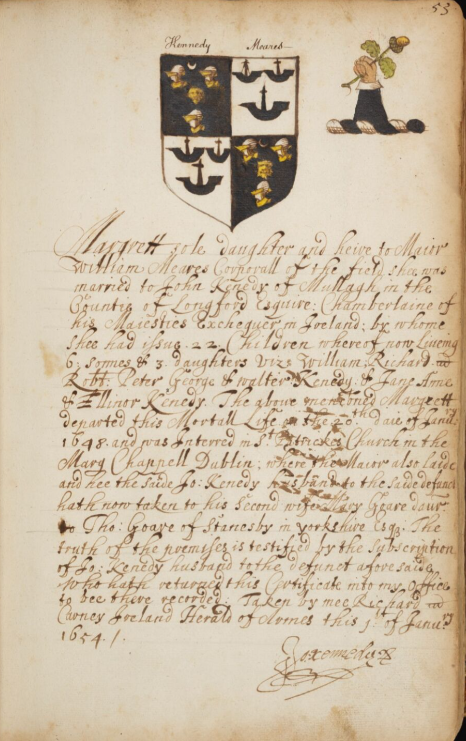
NLI GO MS 70 Page 53r
Darcy’s Spring with VOICES
At the end of the 2025 Michaelmas Term, I had the opportunity to apply to a number of internships that correlated with my MPhil programme in Public History and Cultural Heritage. For me, the VOICES Project immediately stood out as my top choice, as I am interested in exploring how historians and other academics communicate to and with the public. As VOICES is focused on uncovering the stories of ordinary women in Early Modern Ireland, the ways in which these stories are published and consumed by the public are important factors in fully uncovering them. Additionally, the VOICES Project stood out as it focuses specifically on ordinary women and the active role that they played in shaping Early Modern Ireland. For me, the ability to highlight the untold stories of these women through social media presented itself as a meaningful step towards increased public knowledge and engagement.
As the Social Media and Public Engagement Intern, I was tasked with managing the existing social media accounts. In addition, I focused on two main projects: Creating two new social media pages and collaborating with the VOICES historians on blog posts. When I initially started on the VOICES Project, there was already an active and engaged online presence on BlueSky and our own (wonderful) website. In order to expand upon this presence, we decided to add two new social media accounts on Instagram and LinkedIn. In doing so, we were able to expand our audience and reach, both in terms of numbers and the type of accounts. One benefit of Instagram specifically was the ability to have a detailed breakdown of the number and type of accounts engaging with our content. For example, every story post had statistics on the number of accounts that clicked on the story and further explored the post or our account. In turn, I was able to identify our top-performing posts and analyse why they were performing well. The creation of new social media pages, however, did not come without challenges. One that particularly stands out was the challenge of identifying and building up a similar audience to that of BlueSky. As the BlueSky account was well established, our followers were heavily engaged with the content and, in turn, brought in more accounts to the page, allowing our account to grow at a natural pace. For Instagram and LinkedIn, however, we were starting from scratch. By going through our BlueSky followers and engaging with different institutional accounts in Ireland and abroad, I was able to slowly build up a base network of followers for both accounts.
The second project I worked on as part of the VOICES team was the creation of a blog post highlighting the work of Dónal Farrell on the 1650 Census. In March 2026, I was brainstorming ideas for a blog post connected to the upcoming release of the 1926 Census. I was initially drawn to connecting VOICES and the 1926 Census release, as both highlight the importance of ordinary individuals. However, as our team continued to meet and develop the idea, it became clear that there was a much stronger connection between the work of VOICES and the 1926 Census than I had initially thought. As a Research Assistant on VOICES, Dónal had just completed his work on the 1650 Census when it was suggested that we connect the two. Both censuses were conducted at a time of change in Ireland and shed light on the individual stories and lives of ordinary people in Ireland. The 1650 Census, however, provided an extremely detailed description of individuals, including ordinary women, and explicitly recorded Irish language proficiency, highlighting the diversity of those living in the Newcastle and Uppercross baronies at the time. Writing this blog post was meaningful to me, as I deepened my understanding of the importance of the 1650 Census and contributed to the continued work of VOICES.

Richard M. Flatman’s Transcription of the 1650 Census in the Irish Genealogist